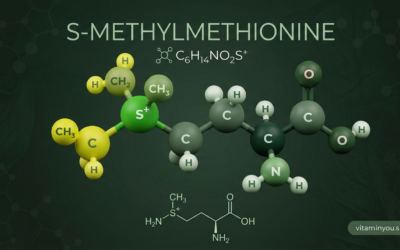

Anyone who’s managed gastritis for years has learned to be skeptical of new products. So let’s go through the Vitamin U safety data directly, including where the evidence is strong and where it gets thin.
What S-methylmethionine is, and why it matters for this question
Before getting to adverse effects, one piece of context worth having: S-methylmethionine (SMM) is not a synthetic compound. It’s a naturally occurring substance found in cabbage, kale, Brussels sprouts, and other crucifers. You’ve been consuming small amounts of it in food your whole life. The supplement is a concentrated, isolated form of the same thing.
This doesn’t make it risk-free by definition, but it does mean the starting assumption is different from a novel synthetic molecule. The compound also has a long history as a licensed pharmaceutical. In Japan, methylmethionine sulfonium chloride has been sold as an over-the-counter stomach medicine (Cabagin KOWA) for decades. (5) In Ukraine, it’s registered as a pharmaceutical drug, used at 300 mg/day in published clinical trials. (2) Neither market would sustain that record without an acceptable safety profile.
What the research says about safety
A 2025 pharmacological review by Doba, Buzlama, Aleksenko, and Sviridova in the Research Journal of Pharmacy and Technology examined the full available literature on MMSC. Their conclusion on toxicity: it is low across a broad range of target organs and tissues, including the stomach, liver, kidneys, skin, eyes, and brain. (1) The review also noted that the existing research base is limited in volume, and more investigation is warranted. That’s a straightforward fact worth knowing.
The full body of published research on S-methylmethionine, including clinical gastritis trials, safety reviews, and animal studies, is compiled in our Global Vitamin U Research Database.
Is Vitamin U safe?
Based on available clinical trial data and pharmaceutical use across two countries, S-methylmethionine has a consistent safety record. No serious adverse effects have been documented in published studies at any dose within the typical supplemental range (150 mg to 1,000 mg/day). The 2025 review cited above specifically described its toxicity profile as low across multiple organ systems. That is the current state of the evidence.
The honest qualification is that most of the data comes from short-to-medium term studies. The longest published trial ran for six months (Drozdov et al., 2023, in chronic gastritis patients at 300 mg/day). There are no multi-year randomized controlled trials on daily SMM supplementation in humans. That’s not unusual for compounds that developed outside Western pharmaceutical pipelines, but it’s better to name it than to pretend the evidence base is comprehensive when it isn’t.
What clinical trials have reported
The Drozdov 2023 trial, which followed 37 chronic gastritis patients taking 300 mg of SMM per day for six months, reported significant symptom improvement at month three and further gains through month six. No serious adverse events were noted. (2)
A 2025 review examining clinical trial data on SMM combined with other gastrointestinal treatments found that a minority of patients in the SMM group reported mild effects, and these did not affect adherence to the treatment protocol. People taking the compound continued taking it. That’s a meaningful signal: in clinical populations with gastritis, who are already sensitive to stomach-affecting compounds, the dropout rate due to side effects was negligible.
At the acute end of dose research, the Salim 1993 trial used 500 mg four times daily (2,000 mg/day) in patients with active NSAID-induced gastric bleeding. Even at that dose, in a medically supervised acute setting, the safety record was acceptable. (3)
Are there any known side effects?
No serious adverse effects have been documented in clinical research on S-methylmethionine at supplemental doses. The specific mild effects that have appeared in some trial participants, though not detailed granularly in every published abstract, are consistent with what you’d expect from any stomach-active compound:
Gastrointestinal discomfort is the most commonly reported class of effect. This includes mild nausea, a sense of bloating, or transient stomach upset. It is most likely to occur when the compound is taken on an empty stomach, which concentrates it in a highly acidic environment. Taking SMM with food is the standard instruction across every pharmaceutical formulation of this compound, and it directly addresses this. See our Vitamin U dosage guide for timing guidance.
No cardiovascular, neurological, hepatic, or renal adverse events have been documented in clinical trials on oral SMM supplementation. The 2025 Doba et al. review confirmed a protective rather than damaging profile for those organ systems based on available data.
There is no documented case of serious allergic reaction to S-methylmethionine in the published literature, though this hasn’t been formally studied in allergy populations.
Vitamin U and drug interactions
No formal drug interaction studies have been published for S-methylmethionine. That’s not a reassurance. It’s a gap. What is known mechanistically: SMM acts as a methyl donor, participating in methylation reactions in the body alongside S-adenosylmethionine (SAMe). If you already take SAMe as a supplement, you are stacking two methyl donors. No evidence of harm from doing so exists, but no evidence studying the combination has been published either.
For most people taking standard supplements like magnesium, vitamin D, or fish oil, there is no known interaction concern. If you take prescription medications, particularly those with narrow therapeutic windows (blood thinners, thyroid medications, certain antidepressants), talk to your prescribing doctor before adding any supplement, including this one.
Can you take Vitamin U with other supplements?
There are no documented interactions between S-methylmethionine and common dietary supplements. No formal drug interaction studies exist for this compound, so the honest answer for prescription medications is: check with your doctor. This applies to any supplement, not only Vitamin U.
Who should check with a doctor first
Clinical trials on S-methylmethionine have typically enrolled healthy adults without major comorbidities. That means a few groups have essentially no specific data:
People with kidney or liver disease: the research doesn’t flag these populations as high-risk, and the 2025 review found nephroprotective and hepatoprotective effects in animal models. But the absence of harm in animals and in healthy trial participants isn’t the same as studied safety in people with existing organ conditions. Medical oversight makes sense.
Pregnant or breastfeeding women: no clinical studies, no guidance. This is true of almost every supplement. Check with your OB.
People on medications affecting methylation or sulfur metabolism: the methyl donor mechanism is worth discussing with a prescribing doctor if this is relevant to your treatment.
What the honest version of “safe” means
The safety record for S-methylmethionine within studied doses is clean. No serious adverse effects in clinical trials, low toxicity across organ systems in animal and human research, and decades of OTC pharmaceutical use in Japan without a significant adverse effects record.
What that does not mean is “studied for thirty years in large randomized controlled trials across every population.” The research base is smaller than that. For people who’ve been let down by products with overstated claims, an accurate picture of what the data does and doesn’t show is more useful than a blanket reassurance.
If you have questions about whether this compound is appropriate for your specific situation, talk to a gastroenterologist or primary care provider who can review your full health picture.
This article is for informational purposes only and is not a substitute for professional medical advice, diagnosis, or treatment. Always consult a qualified healthcare provider before starting any new supplement, especially if you have a health condition or take medications.
This statement has not been evaluated by the Food and Drug Administration. This product is not intended to diagnose, treat, cure, or prevent any disease.
References
- Doba S, Buzlama A, Aleksenko E, Sviridova O. Pharmacological Effects of S-Methylmethionine Sulfonium Chloride (Vitamin U). Research Journal of Pharmacy and Technology. 2025;18(12):5911-6. https://www.rjptonline.org/AbstractView.aspx?PID=2025-18-12-44
- Drozdov VN, et al. Effect of 6-Month S-Methylmethionine Intake on the Quality of Life and Dyspepsia Symptoms in Patients with Chronic Gastritis. 2023. https://pubmed.ncbi.nlm.nih.gov/37346023/
- Salim AS. Sulfhydryl-Containing Agents in the Treatment of Gastric Bleeding Induced by Nonsteroidal Anti-Inflammatory Drugs. 1993. https://pubmed.ncbi.nlm.nih.gov/8443719/
- Kruchinina TV, Makhova AA, Shikh EV, Drozdov VN. S-methylmethionin (vitamin U): experimental studies and clinical perspective. Vopr Pitan. 2018;87(5):70-76. https://pubmed.ncbi.nlm.nih.gov/30592892/
- Cabagin KOWA Alpha Plus package insert. Kowa Company, Ltd. https://hc.kowa.co.jp/en/wp-content/uploads/sites/2/2024/09/CABAGIN_alpha_plus_EN.pdf
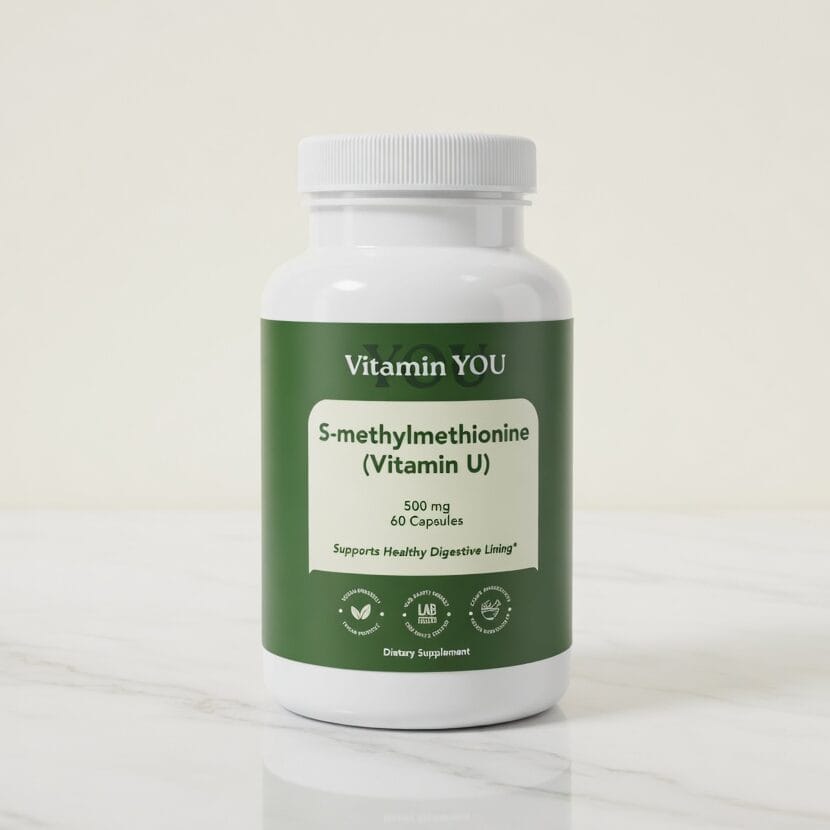
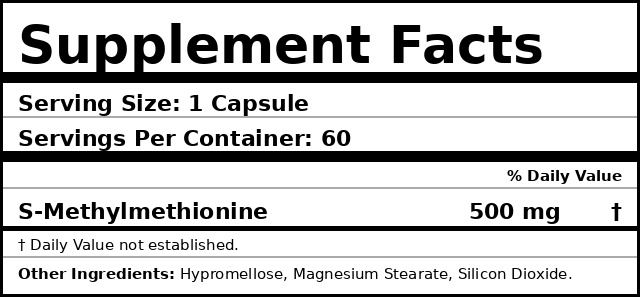
S-Methylmethionine • 500mg • 60 capsules
Vitamin U
Supports stomach lining health.*
★★★★★
Pure S-methylmethionine is the active compound in cabbage juice, studied since the 1950s. Clean formula. Made in the USA.
$49
Free-shipping anywhere in the US
Made in USA
Lab tested 3rd-party
Capsule Vegan
Returns 30-day