There is no official recommended daily intake for Vitamin U (S-methylmethionine) in the United States. It is not an approved pharmaceutical here, and no regulatory body has established a standard therapeutic dose. What does exist is a body of clinical research spanning decades, plus a useful real-world reference point that most dosage guides miss entirely: S-methylmethionine is a licensed drug in both Japan and Ukraine, where it has been used in clinical practice for years. Those pharmaceutical doses give us something concrete to orient around.
What the research and licensed medicines actually use
Japan (Cabagin KOWA, licensed OTC drug): In Japan, methylmethionine sulfonium chloride has been sold for decades as Cabagin, an over-the-counter gastrointestinal medicine approved for stomach distress, mucosal support, and digestive discomfort. The standard adult dose is 2 tablets taken 3 times daily with meals. Each 6-tablet daily dose contains 150 mg of methylmethionine sulfonium chloride. That is the lower end of the documented range: a gentle maintenance dose used by millions of people for everyday stomach support.
Ukraine (Doctovit, pharmaceutical): In Ukraine, S-methylmethionine is registered as a pharmaceutical drug under the name Doctovit. The clinical trials supporting its use in chronic gastritis and erosive gastroduodenal conditions ran at 300 mg per day. A 2023 Russian trial by Drozdov et al. used this dose for six months in chronic gastritis patients and found statistically significant reductions in dyspeptic symptoms and improvements in quality of life by month three, with further gains through month six. (1) An earlier 2018 study from the same group reported 92.3% efficacy in symptom management at a comparable dose.
Cheney’s US research (1949-1956): Garnett Cheney at Stanford used fresh cabbage juice, which contains roughly 100 to 150 mg of S-methylmethionine per litre, in his peptic ulcer trials. Patients drinking a litre daily healed significantly faster than controls, with healing times of around 7 to 10 days compared to the standard 42 days. These are not supplement doses but they establish the low end of the effective range from a different angle.
The Salim 1993 acute trial: At the other end, a double-blind RCT in 172 patients with NSAID-induced gastric bleeding used 500 mg four times daily (2,000 mg total per day) under medical supervision. (2) That is an acute clinical intervention, not a daily supplement protocol.
The full picture: a licensed Japanese OTC medicine at 150 mg/day, a Ukrainian pharmaceutical at 300 mg/day, and an acute intervention at 2,000 mg/day. The research and pharmaceutical record is compiled in full in our Global Vitamin U Research Database.
What dose of Vitamin U was used in studies?
Across chronic gastritis research and licensed pharmaceutical use, the most studied maintenance doses range from 150 mg/day (Japan’s Cabagin) to 300 mg/day (Ukraine’s Doctovit and the Drozdov 2023 clinical trial). Acute clinical trials have reached 2,000 mg/day, but those involved medical supervision for active gastric bleeding and are not relevant to daily supplementation.
How does 500 mg compare to pharmaceutical doses used in other countries?
One capsule of our S-methylmethionine supplement delivers 500 mg. Put it alongside the global pharmaceutical record: it is more than three times the Japanese OTC maintenance dose (150 mg) and about 67% higher than the Ukrainian pharmaceutical dose (300 mg). It is also one-quarter of the acute clinical dose used in the Salim trial.
That puts 500 mg clearly above the gentle everyday range and well below the acute intervention range. It is a reasonable single-capsule dose for someone using this compound for active gastric support rather than mild everyday maintenance.
Across all the research on S-methylmethionine, no serious adverse effects have been documented at any dose within this range. A 2025 pharmacological review described its toxicity profile as low across a broad range of applications and organ systems. (3) If you have a specific health condition or take medications, talk to your doctor about whether this compound is appropriate for you.
Should I take one or two capsules per day?
One capsule (500 mg) daily is the standard starting dose and the right place for most people to begin. It sits above both the Japanese and Ukrainian pharmaceutical doses and gives you a meaningful daily amount for gastric mucosal support.
Two capsules (1,000 mg) may make sense during an active flare. The Salim 1993 trial demonstrated that higher doses of S-methylmethionine were effective in acute gastric situations: 2,000 mg/day was used for active NSAID-induced bleeding under supervision. Two capsules at 1,000 mg is still well below that threshold, and it is a reasonable approach when symptoms are more acute rather than at baseline maintenance level.
Can I take more than one capsule?
Two capsules per day (1,000 mg) is well within the range documented in clinical research. Going significantly higher without medical guidance is outside what the available data supports for unsupervised supplementation.
Timing
With food. That is the consistent instruction across every formulation of this compound, from the Japanese OTC drug to the Ukrainian pharmaceutical trials. Cabagin is taken after meals specifically. Taking stomach-support compounds on a completely empty stomach delivers them into a highly acidic environment and, for sensitive stomachs, can occasionally cause mild queasiness. Once or twice daily with meals is the right approach.
If you are taking two capsules per day, splitting them across two meals rather than taking both at once is sensible.
When is the best time to take Vitamin U?
With a meal, once or twice daily. The Japanese pharmaceutical dosing is specifically after meals. This applies regardless of the time of day. The food timing matters more than the clock.
How quickly will you notice something?
This is the question that matters most to people starting out, and the honest answer has two parts.
Symptom relief and mucosal repair are two different things, and they happen on different timelines.
Some people notice a shift in comfort within hours or a day of taking Vitamin U or drinking fresh cabbage juice. There is a biological reason for this that the research actually documents. One of the mechanisms by which S-methylmethionine works is by stimulating mucin secretion, which is the thick protective mucus layer that lines the stomach wall. Studies in gastric tissue have shown that SMM accelerates mucin production and increases the amount of surface mucus covering the stomach lining. (4) When that layer becomes thicker and more robust, acid has less direct contact with irritated tissue. That protective effect can begin relatively quickly, before any structural repair to the lining itself has occurred.
This is not universal and individual responses vary. But if you notice something shifting faster than you expected, that is likely the mucin mechanism at work, not imagination.
Structural mucosal repair is a slower process. The Drozdov 2023 trial showed statistically significant symptom improvement by month three at 300 mg/day, with further gains through six months. For someone with long-standing chronic inflammation, three to six months of consistent use is a more realistic window for assessing the full structural benefit.
So the practical answer: some symptomatic relief may come faster than expected. Structural support takes longer. Both are real, and they are worth distinguishing.
For context on how the stomach lining repairs itself and what else supports that process alongside S-methylmethionine, see our post on how to repair the stomach lining naturally.
How long does Vitamin U take to work?
Symptomatic relief can begin within one to two weeks for some people. Structural mucosal repair takes longer. The clinical trials showing the strongest results ran for three to six months. The two are not the same, and both are real. Consistency over time matters more than optimizing the exact dose.
This article is for informational purposes only and is not a substitute for professional medical advice, diagnosis, or treatment. Always consult a qualified healthcare provider before starting any new supplement, especially if you have a health condition or take medications.
This statement has not been evaluated by the Food and Drug Administration. This product is not intended to diagnose, treat, cure, or prevent any disease.
References:
1. Drozdov VN, et al. Effect of 6-Month S-Methylmethionine Intake on the Quality of Life and Dyspepsia Symptoms in Patients with Chronic Gastritis. 2023. https://pubmed.ncbi.nlm.nih.gov/37346023/
2. Salim AS. Sulfhydryl-Containing Agents in the Treatment of Gastric Bleeding Induced by Nonsteroidal Anti-Inflammatory Drugs. 1993. https://pubmed.ncbi.nlm.nih.gov/8443719/
3. Doba S, et al. Pharmacological Effects of S-Methylmethionine Sulfonium Chloride (Vitamin U). 2025. https://www.researchgate.net/publication/398421659
4. Watanabe T, et al. Augmentative Effects of L-Cysteine and Methylmethionine Sulfonium Chloride on Mucin Secretion in Rabbit Gastric Mucous Cells. 2000. https://pubmed.ncbi.nlm.nih.gov/10719747/
5. Cabagin KOWA Alpha Plus package insert. Kowa Company, Ltd. https://hc.kowa.co.jp/en/wp-content/uploads/sites/2/2024/09/CABAGIN_alpha_plus_EN.pdf

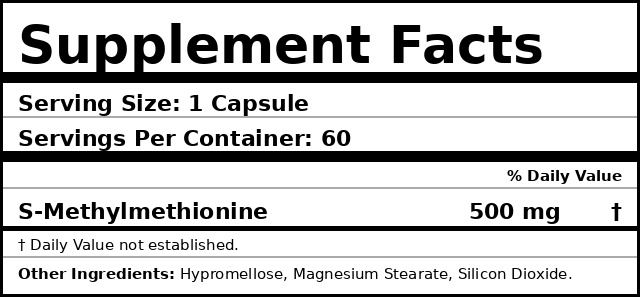
S-Methylmethionine • 500mg • 60 capsules
Vitamin U
Supports stomach lining health.*
★★★★★
Pure S-methylmethionine is the active compound in cabbage juice, studied since the 1950s. Clean formula. Made in the USA.
$49
Free-shipping anywhere in the US
Made in
USA
Lab tested
3rd-party
Capsule
Vegan
Returns
30-day